
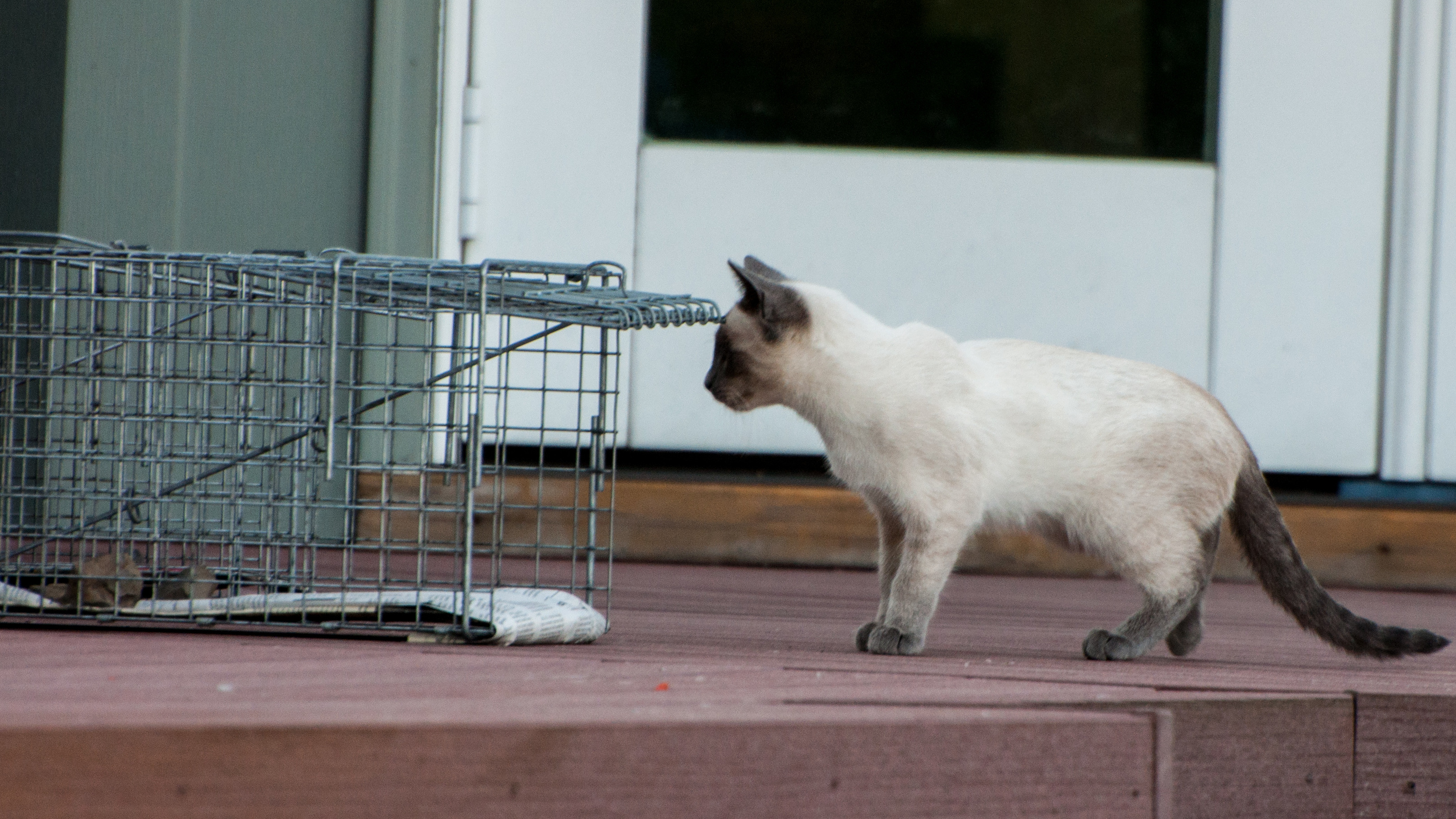
Trapping Feral Cats
Watch FCCO's "How to Trap a Cat" video.
If you are using a Drop Trap, you might want to also check out this video: How to use a Drop Trap


Being able to have access to your different types & styles of traps, & knowing how to utilize them, meant success in trapping all the feral cats in our community.
~ Christina, Feral Cat Caregiver

Before You Begin
All cats must be brought to FCCO clinics in humane traps. Read these reasons why traps are the best choice.
The first step is to get the cats used to being fed at the same place and time of day. Early morning or at dusk are the best times for trapping, but the cats will learn to come at whatever meal time you set for them. Consistency is important.
Plan to set the traps and catch the cats on the day before your FCCO clinic appointment. If the cats have been consistently eating in the traps each day it is not necessary to withhold food; just use the regular food at the regular time. Never leave a trap set overnight and do not trap without a spay/neuter appointment set up.
Do not set the traps and practice trapping the cats days before your scheduled appointment. It is much harder to trap cats a second time. Be careful not to set the traps when training the cats to eat in them. (Refer to “Baiting the Traps” section).
Prepare the area where you will be holding the cats before and after the clinic. A garage, laundry room, bathroom or other sheltered, warm, protected area is best. Lay down plastic sheeting or a tarp, covered with newspapers to absorb any mess. Prepare the vehicle you will use to transport the cats in the same way, with a tarp and newspaper.
Do not trap in the rain or the heat of the day without adequate protection for the traps and only when you can be present.
Be sure to read through to our General Precautions and Trap Troubleshooting tips below!

Preparing the traps
Line each trap with newspaper. Three sheets of the daily paper folded in thirds make a perfect trap liner. This keeps the cats from walking on the wire and will help absorb any mess the cats make while in the traps.
Each trap must be covered with fleece/ sheets or other piece of fabric large enough to completely cover the trap. Keep traps covered at all times.
Baiting the traps
Feeding cats in the traps prior to setting the traps is a very important step in the trapping process. Ideally you will bait the traps for at least 3 days prior to trapping.
Place the traps in the area where you normally feed the cats.
Remove the back door, if using an FCCO trap. For a one-door trap, securely wire or zip-tie the door into the open position.
Feed the cats at a time when you will be available to monitor the traps.
Place the food on a small paper plate or lightweight plastic dish at the far end of the traps so the cats have to go all the way into the traps. Be sure the cats do not have access to the food from outside of the traps. Do not put food anywhere other than inside the traps during this process.
Use the cats’ regular food, use only enough for the cats you are intending to catch, and pick up what is left after each meal. Do not leave food in the traps all day or night; this will attract animals such as neighbor cats and wildlife.
Once you start this baiting process, do not put any food outside the traps; the cats are learning that it’s necessary and safe to go into the traps to eat. If cats that have already been spayed/neutered go in the traps to eat, that’s fine as they’re not yet set. Several days of baiting are ideal, but even one or two days will be helpful.

Setting the Traps
On trapping day (the day before your appointment), set the traps just before the cats’ normal feeding time. If trapping in a public area, try to place the traps where they will not be noticed by a passerby who may not understand what you are doing.
Replace the back doors that you had kept off traps during the baiting process and latch them. To latch a trap door securely, place the hasp (oblong metal piece which is on the bottom of the trap door opening) over the piece of metal the latch goes through. Once the hasp is in place, put the latch through the metal piece and make sure it is closed.
Bait the traps with the cats’ food on the far end of the trap away from the trap door. Be sure that the food is behind the trip plate and not on it. Only use enough food for a small meal.
To set the traps, open the trap door by pushing the top of the door in and pulling the bottom of the door upward. There is a small hook attached to one side of the trap top. It hooks onto a tiny metal cylinder on the right side of the door. The hook holds the door in an open position which also raises the trip plate. When a cat steps on the plate, it will cause the hook to release the door and close the trap.
Cover traps with the fleece/ sheets, leaving both ends uncovered, and set them in the area where the cats eat.
Make sure the traps are on solid, level ground. If necessary, use a towel under the traps to make sure they don’t wobble.
Waiting for Success
Never leave traps unattended. A trapped animal is vulnerable and could get injured inside the trap or a passerby could release the cat, steal the trap, or both.
Wait quietly in an area where you can still see the traps without disturbing the cats, but not where the cats can see you. Your car or house window work very well. Check the traps every 15 to 30 minutes; you can usually hear the trap doors closing. As soon as a cat is trapped, quickly cover the trap completely and remove it from the area. When carrying the trap always use the handle on top of the trap. Do not use the handle for the door in case it is not latched properly. If you are trapping multiple cats, repeat this process until all cats are trapped.
Once you get the captured cat to a quiet area away from other traps, lift the cover and make sure you haven’t trapped a pet or previously neutered feral (look for an ear tip) or a wild animal. If this does happen, simply release the animal as described in the “Return the Cats” section.
When you do trap cats, be sure to keep them in a safe place until time to transport to FCCO. This location should be out of the elements (rain, cold, sun, and heat), as well as a place unable to be disturbed by other creatures or people.
Be sure to keep the traps covered - including when bringing the cats to the clinic.

Recovery
When you pick up the cats from the clinic, they will still be groggy from their anesthesia.
Keep the Surgery After Care Instructions that you received when you picked up the cats. All of the information you need to know about what to watch for is on this form. This form is also your record of what services were done for the cat that day.
The cats will spend the night in the traps in the area you have prepared for them to recover and be released the next day in the same area where they were trapped.
Do not transfer the cats from traps to carriers. The cats actually do better in the traps and it’s cleaner for them as well since any urine produced can drain out the bottom of the trap.

Returning the Cats
Do not relocate the cats to an area where they were not trapped. This is dangerous for the cats without the proper preparation.
When ready, turn the latched door away from you, unclip and remove it, and let the cats run out.
Never put your hand in the trap. If a cat does not go out immediately, walk away from the trap and watch from a distance until the cat leaves the trap.
Cleaning and Return of Traps
Return the traps by the date specified on your trap agreement.
Remove and discard all stickers, tape and newspaper.
Use warm, soapy water and a scrub brush to remove all remaining debris. Rinse thoroughly several times with clean water.
Do NOT use bleach; it is damaging to the trap and bleach residue is dangerous for cats. All traps will be safely disinfected by FCCO before they are used again.
Once the traps are returned clean and undamaged, your deposit will be returned to you.

General Precautions
Any bite or scratch should be taken seriously- seek medical attention immediately. If possible, DO NOT RELEASE the cat. The cat must be quarantined. Contact the animal control agency in your area for quarantine instructions.
If you have any questions regarding the trapping process please call FCCO at 503-797-2606. We listen to our messages frequently and will return your call as soon as possible.

Trap Troubleshooting
The trap is too sensitive when I try to set it.
Call the trap depot where you picked up traps and get a different one.
Put some paper into the folded space in the trap door. This makes the door thicker and the trapping mechanism less sensitive.
Do not set the trap to catch the cat if the trap is too sensitive.
I have several cats and I want to catch a particular one.
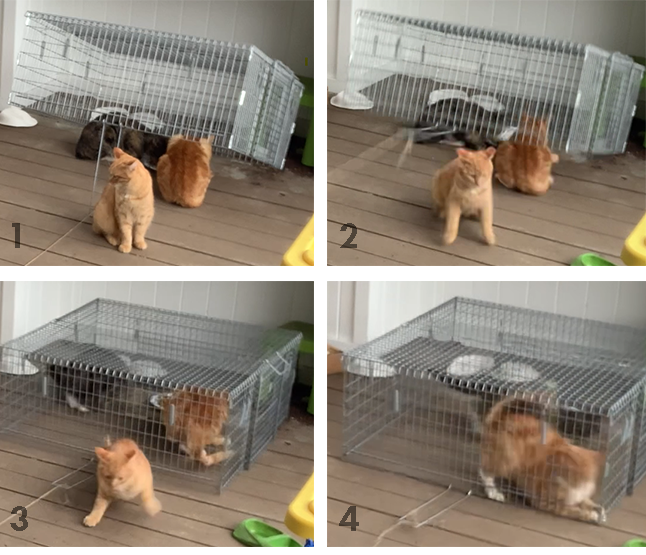
A drop trap is a larger, box-like trap which simply drops down around the target cat(s) when you pull a string.
Get enough traps for each cat in the colony. Trap all the cats and hold them in the traps while trapping the remaining cats. As soon as you catch the target cat then release the other trapped cats. Do not use this technique to trap and release unfixed cats.
Use the “water bottle trick.” Instead of setting the trap normally, prop the trap door open with an object like a water bottle. Tie 20+ feet of string to the object and then wait for the target cat to go all the way into the trap and begin eating. Pull the string so the trap door closes quickly behind the cat.
Use a drop trap. This is a larger, box-like trap which drops down around the target cat. You must be present to use this trap. Call the FCCO office for availability.
Use a remote control and trap attachment. This allows you to only have the trap go off when the target cat is inside and you press a button on a remote. Call the FCCO office for availability.
I’ve been baiting the traps for more than 3 days and the cats won’t eat inside the traps.
Do the cats have access to food outside of the traps from you or from a neighbor?
If you have food available to the cats outside of the traps then the cats have no motivation to eat inside the traps. Remove any food outside the traps, including dry food.
If you suspect a neighbor may be feeding the cats then go speak with the neighbor and ask them to remove the food while you are trying to trap.
Use smelly food to entice the cats into the traps. Tuna, KFC chicken, sardines, mackerel and smelly wet food are all good choices.
Borrow one of our larger traps with a clear door. This tricks the cats into thinking both ends of the trap door are open.
Use a drop trap. This is a larger, box-like trap which drops down around the target cat(s). You must be present to use this trap. Call the FCCO office for availability.
The cats are stepping over the trip plate to eat or the cats are able to pull out the food without setting off the traps.
Use the “water bottle trick.” Instead of setting the trap normally, prop the trap door open with an object like a water bottle. Tie 20+ feet of string to the object and then wait for the target cat to go all the way into the trap and begin eating. Pull the string so the door closes quickly behind the cat.
Tie some chicken inside the back of the trap in the top corner. This will change the way the cat has to stand in the trap and will keep the cat from pulling the food out.
Fold the newspaper so that it just reaches the end of the trip plate. Put some food on a piece of a paper plate and set it on the bottom of the trap past the trip plate and the newspaper. The cat will have to reach in further to eat and will not be able to pull the food out.
The cats are not coming to eat regularly.
Do you leave food out at all times? Try feeding during a smaller window of time during the day. Continue to make this window of time smaller until the cats learn to come within a 1 hour time frame to eat.
Talk to your neighbors to see if the cats are eating somewhere else in the neighborhood. Many cats go back and forth between several different feeders. Ask them to temporarily stop feeding the cats while you are trying to trap and spay/neuter or ask if you can put traps where they normally feed the cats.